



In 2025, humanoid robots crossed a Rubicon: for the first time, they began to be sold not only to corporations but also to everyday consumers. Unitree R1 and 1X NEO — pre-orders are already open for these home-use models.
The pace will only accelerate. China plans to produce 10,000 humanoids annually by 2027; Elon Musk is launching mass production of Optimus Gen; and Morgan Stanley analysts forecast a $5 trillion market by 2050.
Yet alongside these successes, hundreds of memes circulate showing humanoids falling, breaking down, or failing at simple tasks. From a product that costs tens of thousands of dollars, consumers expect high efficiency and autonomy — but can today’s robots actually deliver? What really happens beyond the glossy promotional videos?
Why Robots Fall (and Not Only That)
Humanoids for business are already at work: in factories in China, in Amazon warehouses, at BMW plants. Incidents do occur, but in such environments robots perform tasks at a high level. That’s because these settings offer predictable routes, time-planned actions, and repetitive processes.
But move the same robot into a typical home — where space is more chaotic and unpredictable — and it risks becoming just another meme. Any moving object, such as a child or a cat, changes in the environment, or additional obstacles along the way can easily confuse it. These challenges can be addressed in experimental settings, but not yet at the scale of industrial production.
https://www.facebook.com/watch/?v=1838580630080885
Moreover, when someone buys a humanoid for $20,000 (and even then, one controlled by a remote), they expect a universal assistant — one that cleans, cooks, brings items, takes care of children or elderly parents, understands commands, and works for long periods without recharging. Modern robots cannot promise all of this at once. And the polished video presentations where humanoids neatly fold clothes or manipulate fragile objects are rarely filmed in a single take — or the robot is actually controlled by a human teleoperator.
Humanoids are designed to resemble humans, but from a technical perspective, reproducing a human inside a metal shell is extraordinarily difficult. Here are the biggest challenges science faces today:
● Fine motor skills — the human hand remains unmatched. Current actuators do not provide the necessary combination of sensing and mechanics for stable grasping of diverse objects.
● Navigation in changing environments — a robot must instantly re-plan routes, recognize new objects, and predict the behavior of people and animals. Computer vision systems are advancing rapidly, but they still lack sufficient adaptability.
● Sensors and maintenance — human skin heals itself; industrial sensors do not. Batteries, mechanisms, and sensors require regular replacement due to wear.
● Balancing on two legs — the human foot contains 26 bones and 33 joints that instantly adapt to surfaces. Stairs and obstacles remain a challenge for humanoids. Wheeled platforms are often more efficient — but psychologically less appealing.
● Multitasking — a robot may outperform a human at a single task, but handling 5–10 different tasks over several hours is beyond its capabilities. Even with AI, computing power is still insufficient.
● Autonomy — most humanoids operate only 2–4 hours without recharging, although models capable of swapping batteries autonomously are beginning to appear.
Accepting Reality: We Are Only at the Beginning
Humanoids have been studied for decades. The first full-fledged prototypes appeared back in the 1980s, yet even today they are only catching up to the basic capabilities of the human body. Humans evolved over millions of years, so reproducing our flexibility, sensory systems, and behavior in one or two decades is impossible — although the pace of progress in recent years has indeed been unprecedented.
Thanks to artificial intelligence, robotics has made significant strides and gained momentum, but development will be gradual rather than leap-based.
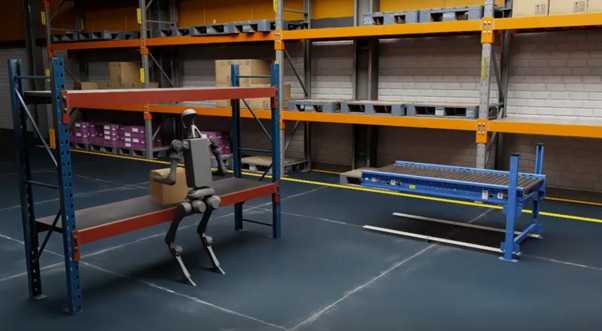
The key challenge at the current stage is teaching robots to interact with the physical world. Real environments are unpredictable, mistakes are costly, and experiments involving people are dangerous. That is why most progress today happens in virtual environments — digital twins of real spaces.
High-fidelity simulations allow engineers to model and test hundreds of thousands of scenarios: falling objects, lighting changes, sensor failures, unexpected obstacles — without risking equipment or human safety.
For example, at SoftServe, on one client project, humanoid robots are trained in digital twins of warehouse facilities, where they learn to move, manipulate objects, and respond to dynamic environmental changes before ever entering the real world. The same approach is used in manufacturing — to simulate robot operations on assembly lines; in logistics — to optimize routes for autonomous platforms; and in vertical farming — where digital twins make it possible to test growing scenarios without risking crops.
Training humanoids is a long, phased process — and manufacturers do not hide this. Real progress is only possible through simulation, real-world experience, and failure. First, robots master basic movements in virtual environments; then they learn human actions via teleoperators; and only after that do they attempt to perform tasks independently. This is how humanoids adapt to a world that was designed not for machines, but for humans.
When Will Humanoids Become Everyday Reality?
In industry, robots have been performing critical tasks for the past 70 years. KUKA, FANUC, and ABB robotic arms execute millions of cycles with microscopic deviations. Mobile platforms operate in areas that once required entire teams of people.
In medicine, the da Vinci surgical system performs more than a million operations per year with millimeter-level precision. In 2025, autonomous modules were introduced that can independently suture wounds or perform laparoscopic procedures.
Still, there are fields where the humanoid form truly matters. Psychologically, people find it easier to work alongside something human-like — we read intentions more easily, trust more readily, and are more forgiving of mistakes. Here are several areas that are already ready to deploy humanoids today:
● Factories and manufacturing — the most natural domain for humanoid robots, since industrial infrastructure is designed for humans: doors, handles, buttons, stairs. A humanoid can integrate into production processes without requiring a factory redesign. The first large-scale deployments are expected on production lines, inspection routes, and high-risk facilities.
● Hazardous environments — power plants, chemical facilities, areas with high temperatures or toxicity. Wherever risk to humans is elevated, humanoids are particularly valuable.
● Healthcare and caregiving — a potentially massive niche. Robots can assist with rehabilitation, physical therapy, and patient mobility. A humanoid evokes empathy, making interaction more comfortable. However, this also requires psychological and ethical preparation of society.
At the same time, public discussions often raise fears that robots will gradually replace humans, leaving people without jobs. In practice, humanoid systems are primarily viewed as support tools — for routine, physically demanding, or dangerous tasks. Human roles shift instead toward supervision, decision-making, and handling exceptions.
Against the backdrop of population aging, demographic change, and skill mismatches with modern needs, demand for automation and additional labor is growing. In the near term, this means mass production of humanoids primarily for factories and manufacturing, while the emergence of household robots remains more a matter of 5–10 years — not only due to technological limitations, but also because of regulatory requirements, privacy concerns, and ethical barriers.